Crossing Paths

Crossing Paths
Model Melbourne trams

Sunday, 8 May 2016

Phaffing about

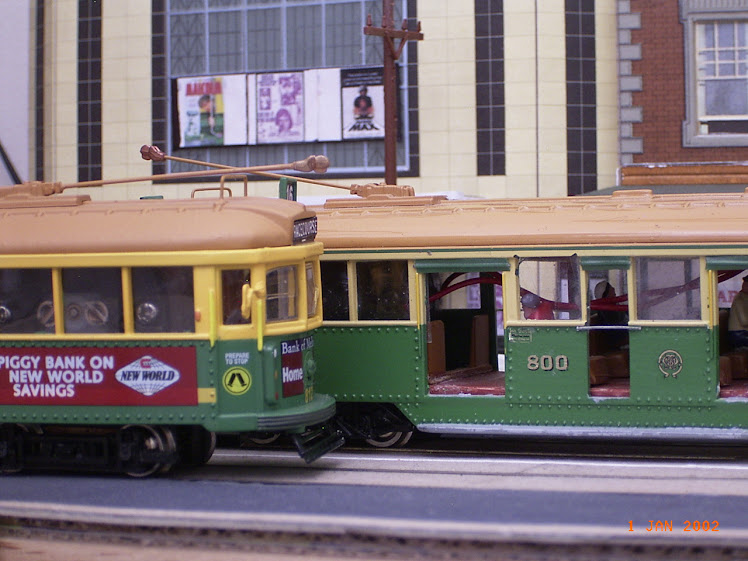
The last month after knocking over the depot shed, work and life has conspired against me. On the odd occasion  I tend to shuffle trams in and out the roads of the depot shed, along the stretch to the racecourse back to the ammo factory then back into the sheds.

 
Busy times at the depot.

The other thing I doodle with is time tabling, especially when I'm on dad duties, roughly drawing train graphs of arrival and departure times that allow for short shunting special services to and from the racecourse that also in turn need to avoid conflict with regular services. The backs of envelopes, pages from a scribble pad, scraps of paper all provide a medium for creativity while supposedly supervising small children.

I did manage to visit a hobby shop, I obtained some sanitation based objects, old school rubbish bins (none of those 'modern' wheelie bins), and a Victorian era public convenience for the Ammo factory terminus. As per usual the facilities were kitbashed to suit my requirements, as the original concept was again too large for the area provided.


I bet the ratepayers of Victoria Street are happy with the local council.
 

Loitering or stage fright?

The other purchase was a replacement motor for 812, as this tram had a history of coughing and farting after about fifteen minutes of continuous running, the current draw of the original motor was diagnosing an issue with one of the windings, the decoder after the stated period would kick in 'self preservation' mode so as not to allow the 'magic smoke' escape.

The replacement motor is one for the Auscision brand of Australian prototype locomotives, the centre height was spot on, however the diameter of the new motor is about .070" wider than the original, so some old tech school bench fitting was required to make it fit inside the split chassis of the Cooee Collectable mechanism.

 
I will make it fit.

The replacement motor also has some massive brass flywheels that may in someway affect the tides of the planet and not to mention the ability alter the course of the space time continuum. The original drive shafts to the gear towers had to be extended to accommodate the new motor, now I have a tram that could out pull most of the model locomotives going around if I could be bothered with fitting it with some kadees.

 
812 is finally back in service.
 
So there it is, in a nutshell. I have spent the last month phaffing around.

From a slightly busy work bench under the wires.
Glenn.


Monday, 4 April 2016

Works at the Depot.

The brickies have been in and the depot shed is starting to resemble something like a tram shed and less like a cool store, This is the largest and most intact structure on Victoria Street, it is also the final one.

 
A typical day on the tramways.

The brick sheet used is Superquik pasted onto the foam board with a glue sick, concrete lintels and bases are cereal box card,  the roof is in the process of being finished off with Wills corrugated iron.

The space between the shed and the office features the former substation that used to serve the depot and the line to the Racecourse and the Ammo factory,  The original rotary converter installed when the depot was isolated from the main system inside has been mothballed and the space is used by maintenance as a store. This was made up from leftovers from the Ammo Factory building, a Metcalfe Warehouse kit.

 
The substation/stores

Depot signage has either been scanned from books or sourced from the internet, resized in windows word then printed out on office paper.

Here are few more photos in and around the new depot shed.

 
4MPH in the yard.
 
 
Carring out from the sheds.
 
 
About to enter service.
 
 
Road 3 at the rear of the shed,
the entry/exit point of rolling stock for the layout
 
 
The whole depot lends itself to an inglenook shunting puzzle, which means that in order to run a tram from the back of the shed, one has to shuffle and shunt trams in and out and try not block the traffic out the front of the depot for any extended period of time. some trams are sent over the crossover to the Ammo Factory to hide for a few moments, others provide 'double shunts' at the depot entry, all in all fun and thinking all round.
 
Now for the fun part, the overhead.
 
From under the roof at the end of the layout.
Glenn.


Sunday, 6 March 2016

There is a fine line between detail and insane.

I have been in the process of installing lights into the two SEC trams, Ballarat 28 and Bendigo 29. These trams were DCC chipped nearly two years ago, they had their CVs tweaked and have been in regular service since.

 
County cousins from about 2 years ago.
 
However a tram without running lights can be a hazard to itself and to others, for when it is called up by the controller, you have no clear idea which direction it will go when it moves into step one, (usually into the tram 'behind' it at the depot), nor can you tell if it has stalled on dirty track or it's just being difficult.

That's the thinking behind about fitting lights are, the headlights let you know which way it should go and the saloon lights inform you that the tram is receiving power and is waiting for further instruction, this sums up the detail aspect.

The insane part of this blog, is that both trams are of the single truck four wheel variety, (Ballarat 28, a reworked tyco/mantua trolley and Bendigo 29 a JEM resin kit on an Bachmann 44t powered bogie) therefore there is a distinct lack of real estate inside these models, even when you have installed rather small decoders, there is the space consumed by the mechanism, then you decide to install headlights, marker lamps and interior saloon lights as well, enter the two blokes with the straight jacket and a few sessions of weaving cane baskets!

 
The mechanism of Bendigo 29, with a socket on top
fashioned from half an eight pin IC socket.
 
 
The innards of Bendigo 29.
With three LEDs at each end, two warm white, on red.
 
What makes this concept more interesting is that I install LEDs with dropping resistors for lighting, but as I choose not to incinerate surface mounted LEDs for these projects, no, I use the more robust 3mm LEDs, warm white for the headlamps, red for the tail/marker lamps and yellow for interior lighting.

With the marker lights, I use 1mm(.040") fibre optic thread/element that is heat shrunk to the LED, and to ensure that the 'magic smoke' does not exit the decoder, all leads of components and wires are heat shrunk and insulated. All of which is in the confined space of these trams.

 
The marker light assembly, a warm white LED with heat shrink
surrounding the two smaller heat shrunk sleaves that the 1mm Fibre optic
element will press fit into.
 
 
Testing the marker light assembly before installation.
 
Ballarat 28 was just as entertaining to do, and was fitted out in a similar way. The results speak for themselves
 
 
Ballarat 28 & Bendigo 29 passing outside the Grand Theatre,
 
 
and earlier in the evening along Victoria St.
 
 
Then back at the Depot later that night.
 
 
From under the wires with little trams in the dark.
Glenn

P.S. This is the 100th post of Victoria Street.


Wednesday, 24 February 2016

We're havin' ourselves a barn raisin'

All good depots need a shed, a tram shed/car barn, somewhere to berth and then service rollingstock after a hard days work, and in the situation of Victoria Street, somewhere to hide rollingstock from the domestic curse of household dust.

 
The Depot shed with W5 800 on the kitchen bench
(The place where all good models are photographed)

After the construction of the depot light and overhead array, I have been trawling cyberspace for a suitable structure to 'plonk' over the frame, I have settled on a traditional 'saw tooth' design that will allow ambient light during the day but will 'light up' in the evening when trams are retiring for the day.

A simple construction made from 4mm foam board, this grand shed spans the three roads of the Albert Road/Westside Depot, the roads, numbering from 1 to 3, left to right.
This is enough to serve the requirements of this cross suburban line with a little more space for a few heritage units for weekend gunzel* excursions.

 
Hiding in the shed

At the rear of the shed, road three runs through to an external yard (loading ramp), this is the entry/exit point for rollingstock on the layout.

 
A shot from the rear door of road 3,
looking out onto Victoria Street

More details to be added, brick paper, roofing and so forth, but it is a tram shed.

From under the wires inside the shed,
Glenn.

*Gunzel ( noun, slang Australia especially Victoria): A person who pursues useless and pointless railway enthusiast activities. Verb (intransitive) to gunzel, to go gunzelling.
UK equivalents: gricer, anorak.
USA equivalents: foamer, foamite.

Sunday, 14 February 2016

Lunar new year on Victoria Street.

As a nod to our Asian/Oriental friends at this time of the year, the lunar new year festivities have been going off around town with a lot of red and gold, some pyrotechnics, and a chance to get a cracking feed.

 
"Dad, can I keep him? He followed me home"

This celebration highlights the diverse cultures that exist in historical and contempary Australia, the Asian/oriental component started with the gold rush of the mid nineteenth century, when thousands of hopefuls descended from all parts of the world to try their luck at the diggings of Ballarat and  Bendigo.  This included a fair contingent from mainland China, the goldfields were a rough and tumble environment, upon which fortunes could be made very quickly while others suffered the drudge of working for survival.

The Chinese miners at the time were resented for their ability to work over previously worked ground  collectively and still manage to turn a profit, this led to a discriminatory landing duty of  £10 for any man landing in the Colony of Victoria from mainland China.  This tax was thwarted by the miners landing in the next colony of South Australia then trekking across to the border to central Victorian goldfields.

One party of Chinese miners in 1857 while en route from Robe, South Australia to the goldfields, struck gold at the Canton Lead (Ararat, 92km west of Ballarat), which led to the establishment of that town.


As the alluvial gold diminished, leading to the deeper mechanised mining techniques utilising underground shafts and drives, the Chinese miners moved into mercantile industries such as market gardens, restaurants and specific business aligned with their communities. Little Bourke St, Melbourne is home to one the longest continuous operating 'Chinatown' in the western world and there are still temples and joss houses in Ballarat and Bendigo.


The lunar new year is also celebrated by a more recent arrival, the South Vietnamese, they refer to it as Tet. After the fall of Saigon which signalled the end of the long protracted conflict in 1975, thousands sought refuge outside Vietnam by attempting the perilous journey across the sea.


Upon processing and resettlement many Vietnamese created 'Little Saigon' enclaves in the Melbourne suburbs of Footscray, Richmond and Springvale, thus in filling these tired shopping strips with exotic grocery stores, butchers, fishmongers with restaurants that serve variations of the Vietnamese national dish of noodle soup called phó (pronounced fer), this fragrant broth with either chicken or beef strips and rice noodles when done well can have the restaurant with a queue out of the door waiting to be served.


These communities with differing histories in Australia that share a common calendar, welcome their new year with similar ceromonies that involve colour, food and fireworks with family and friends.

 
Lining up for a feed


This is what I love about Australia, variety courtesy of immigration, otherwise we would be stuck with stodgy meat and three veg forever.


So welcome to the year of the monkey.


From the red confetti of exploded crackers littering the street that's under the wires.
Glenn


Thursday, 21 January 2016

January Shutdown Works 2016

"Service changes apply to Victoria Street trams from Monday, 11 January 2016 to Wednesday, 20 January 2016 due to network upgrade work at The Junction.
As part of the modernisation of Melbourne's tram network, The Tramways are installing signalling equipment and repairing and renewing tram tracks and overhead at The Junction.
  • Information about The Junction upgrade including expected impacts for motorists and local residents

Service changes for tram passengers 

  • Service changes to Racecourse
  • Service changes to The Ammo Factory
  • Getting around the work zone
WheelchairPram An accessibility bus is available at The Junction between 10am and 6pm to assist customers with mobility aids, prams or the elderly.
During the work, trams and replacement buses will operate to the normal frequency. However they may not arrive at the scheduled time. The Tramways suggests that you allow extra time for your journey."

As I have done for the last two years, I attempt a fair crack of work on the layout that I have been planning for the last few months.

This time, the projects completed are,

- The illumination and positioning of all structures left of the railway bridge.
- The installation of backboards to all of the newer modules.
- The installation of a road indicator board for the three way point of the depot.
- The installation of the signalling system for trams entering and leaving the depot.
- Repairs/modification to the overhead on the rest of the layout and under the railway bridge.
- The installation of a flickering light module for the backyard incinerator.

My previous experience in industrial maintenance gives myself the opportunity to plan and strategise the approach that I take on 'major projects', unless there is an urgent reason to do some maintenance/repair, all other wish list items can wait until the 'shutdown'. 

The illumination and positioning of all structures left of the railway bridge.
 
 
Departing the Ammo Factory

 
From inside the Depot.
 
 
The Victorian terraces.
 
 
Outside the Depot.
 
 
The pub and the tidy overhead under the bridge.
 
 
The Servo.
 
 
Victoria Street at night looking from the Ammo Factory.
 
 
The installation of backboards to all of the newer modules.
 
 
The Ammo Factory.
 
 
The Depot.
 
 
The Junction.
 
Trying to colour match your previous effort to your current effort, is near impossible for most blokes as we are usually colour deficient.  
 
The installation or a road indicator board for the three way point of the depot.
 
 
The tidy facia that hides that madness underneath.
 
 
 A quick video of the magic.
 
 
The madness...
 
The best way to describe this ensemble (mad woman's hat) is, that both coat hunger wires connects to both point throw bars and the limit switches by the use of junction connections and bent up paper clips, the limit switches feed into the output terminal strip (below left), upon which is fed into the input feed board (left of centre), which in turn feeds into the diode matrix board (upper left) which drives the digital display (left on the control nobs), all old school D.C. driven.
 
The installation of the signalling system for trams entering and leaving the depot.
 
 
A similar mechanical system as the Depot point,
combined with a DPDT switch for depot entry/exit.
 
 
With another rats nest diode matrix.
 
How it works......
 
A tram wishing to enter the Depot, throws the car in/out switch to in, sets the points to enter the Depot, therefore sets the signals against through running and exiting the Depot.(note the tiny red 'T' light signal)


The tram waits at the repeater stop light at
the exit from the Ammo Factory.
 
 
Another stop light for trams from the 'City'.
 
 
Along with protection from trams coming from the Depot.
 
 
Now the tram has clearance to proceed into the Depot.
 
 
After the points are reset for through running and the
switch set for car out, the through service can proceed.
 
Repairs/modification to the overhead on the rest of the layout and under the railway bridge.
 
 
Ballarat 28 trundles under the reworked rail bridge.
 
The railway bridge on Victoria Street has a long history, for most of the layouts life, it was the end of the known world. I had originally wired the trolley wire under the bridge by the use of brass thumb tacks and an appalling effort of soldering copper wire to this dubious assembly, which resulted into numerous dewirements and snagged pantographs.(even though Victoria Street now runs two rail DCC)
After the Depot frame construction, upon which I utilised N scale code 80 rail for a more solid form of an interior overhead, I decided to use the same material for under the railway bridge. As the bridge had received a knock at the Caulfield exhibition (almost a year and a half ago!), I thought I would use this down time to rectify the problem. Code 80 rail plus two part epoxy, wins.
 
The installation of a flickering light module to the incinerator.
 
 
The innards from a flickering LED tea light candle.
 
 
Nothing too scientific here.
Just ditch the battery and install a 1K resistor in series when running from 12V.
 
 
and tada, a backyard incinerator!
 
 
from under the baseboards.
"We thank you for your patience and regret any inconvenience caused by this essential renewal work."
Glenn