Crossing Paths

Crossing Paths
Model Melbourne trams

Thursday, 3 July 2014

Taking a step back to go forwards.

Now that all the modules have now been rewired with the DCC bus, finer details are now being added to individual modules.

The railway station module, being the master module, from well before DCC had been fitted with lights and internal details, the challenge is to retrofit the other modules.  The Racecourse module has just had street/effect (tree) lights fitted, which is good because now I can run trams again, be it on a truncated layout.


The end of the line at the end of the day.


Victoria Street in its original profile.


Now I wonder if the substation can handle all of this.


Plug and Play
(DCC bus plugs and lighting [RCA] plugs)
The terminal strip will allow potential grounded rail/overhead running on DCC 
 
The LED lighting was starting to drive me mad, streetlights too bright, effect (tree) lights too dim, and I had enough of sampling/changing fixed value resistors for the look I was after, so I installed 1K ohm mini trimpots inline to each circuit, (yes, we now have dimmable mood lights!)  The feed into the trimpots has a 470 ohm resistor in series as safety in the event I bottom out the trimpots to zero ohms when adjusting brightness.
 
Now not to get too distracted from the other tasks.
 
From under the streetlights and the wires.
Glenn


Monday, 23 June 2014

Table cards and run numbers.

Now that Victoria Street has more operational flexibility since the installation of DCC, the concept of prototypical operation (timetabling) now looks more appealing, trams being by nature are a single running locomotive, running with very tight headways with others, using shared road space with other traffic and adhering to their own rules amongst themselves in regards to procedures and processes.

I spotted this online at vicsig, it involves the magic and the mayhem behind tramway operations, each tram is given a run number when in service and is operated by the driver by their instructions on a table card.

The table card is the 'job sheet' of the drivers duties for the day, time of departure, checkpoints 'en route',  meal breaks and other duties as delegated.

The run number is the schedule of work/service the tram is on, (similar to aircraft flight numbers, a designated service between point A and point B at a certain time by a certain airline), in this case the run number exists for that reason for the responsibility of the operating depot/service for that tram.

In days of yore, the run number and depot was displayed on a 'plate' that was hung on the leading near side window of the cab, mainly for the benefit of the relieving driver and/or inspector, (who would be supervising scheduling.)

 
W5 782 parked up at the siding at West Maribyrnong
(Note E21[Essendon 21] on the plate)
photo courtesy of trams downunder 
 
Now for operational reasons, I am not going to install incredibly small run numbers to my fleet, a small white/chalk board with the tram number matched to a run number. (eg 782-E21 as above) should suffice.(Did you picture model trams with post-it notes on them? I did)
 
The 'depot' that 'operates' Victoria Street is the fictitious 'Westside Depot' and for some unknown reason has the letter allocation of  'F' (go figure!). I have (with much infuriation) developed an excel spread sheet with some sort of a series of table cards that co-inside with run numbers that 'may' permit the multiple operation of services.
 
 (sample) THIS IS A WORK IN PROCESS!
 
Run No table no 1 run 2 run 3
101 1 3
City (fiddleyard)down 11:36 11:00 11:30
Railway station 11:39 11:03 11:33
Racecourse 11:40 11:04 11:34
Racecourse 11:46 11:10 11:40
Railway station 11:47 11:11 11:41
City (fiddleyard)up **** 11:14 11:44
City (fiddleyard)down **** 11:45 12:15
Railway station 11:55 11:48 12:18
Racecourse 11:56 11:49 12:19
Racecourse 12:02 11:55 12:25
Railway station 12:03 11:56 12:26
City (fiddleyard)up **** 11:59 12:29

 
Like all well choreographed masterpieces,(as in life and in art), this may and will turn to dust at the drop of a hat, and that's when the fun really kicks in, trying to get this all to work on a 3:1 fast clock and then trying to adjust running when 'stuff' happens.

I'm looking forward to giving it a crack.

From under the paperwork, and under the wires.
Glenn

PS. The works are continuing with the DCC bus conversion quite nicely. thanks for asking.
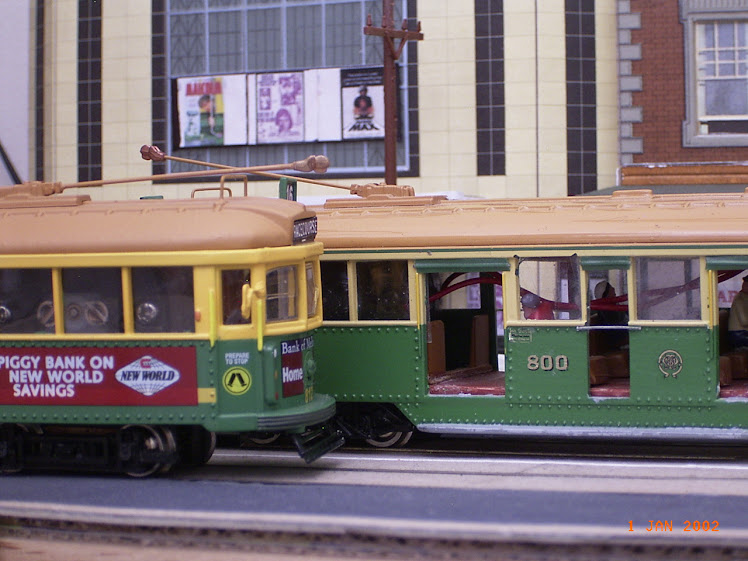


Sunday, 1 June 2014

Cutting the umbilical cord

I have now entered the final phase of converting Victoria Street to DCC operation, the block wiring that was initially was installed for DC operation has not been fully utilised since the adaption to DCC. This has been part of the plan since early last year!

There were seven blocks on Victoria Street, each block was wired to a DPDT switch with a centre off position, which allowed two controllers to control two trams at one time, since the adaption to DCC, all switches have been thrown to one side; therefore one controller, the powercab.

The infrastructure to support this arrangement resembled a rats nests of wiring and terminal strips, which when I took Victoria Street on the road or removed a module for some work, made it feel like I was reinstating a telephone exchange after a natural disaster.

So therefore, I have now bitten the bullet, and now in the process installing a DCC bus with plugs at either side of the modules for a more flexible and quicker setup and pull down arrangement. The bus wire is sourced from 2.5mm* domestic household TPI, (if it can handle 16A at 240V AC, it will handle DCC!)


Out with the old, the block panel and its umbilical cord.
  
However DC has not completely been removed from the equation, a DPDT switch has been installed including a DIN socket so the 'Cashless and Broke' inertia DC controller can control the layout if I wish to run one tram (at a time) that has not been chipped yet (a new purchase).


A new addition on the NCE PCP.
 
The Railway Station module is the first module getting all the attention, and now it is the master module, in the process the pub received some more detail to its lighting, inside and out.
 
 
Rocking out at the Railway Hotel with its neon sign and disco lights.
  
  
At the moment Victoria Street is currently a diorama.


The next modules to get the 'treatment' will be the Racecourse and the Fiddle yard, so I can still run some trams while The Bend and The Gates undergo a retro fit of lighting and bus wire.
 
From under the wires and with the smell of hot solder.
Glenn


Saturday, 24 May 2014

Bush Week on Victoria Street

 
Bush week (1) n,[Aust slang],an agricultural show held in the city. (2)[Aust informal] An imagined or symbolic time when assumedly unsophisticated people from the bush come to the city, likely to be preyed on by tricksters there.

I finally got around to fitting decoders into my homage of the former SECV (State Electricity Commission Victoria) tramways that operated in regional Victoria in Ballarat, Bendigo and Geelong.

These regional tramways literally ran on the smell of an oily rag, their rollingstock were made up of the cast offs from Melbourne and Adelaide and some still to this day, cut a notch at their respective tramway museums.

Bendigo Birney 29 and Ballarat 28 return from the
racecourse on an enthusiasts trip.
 
These models are still undergoing final adjustment to speed tables, kick rates and strengths before the real fun of fitting lights begins. (so far, so good no magic smoke has escaped yet!)
 
Ballarat 28 (a reworked Tyco/Mantua)
 
Holding up services at the racecourse.
 
Country cousins running amok in the city.
 
 
From under the wires in a darker shade of green,
Glenn


Wednesday, 30 April 2014

Open door policy in the workshops

To some it sounds like a trendy theory about transparent management, but in the W class trams of Melbourne it is usually about air conditioning with a dash of human interaction with the travelling public.

The leading near side cab door in the open position offers the trammie some fresh air, and with both cab doors open allows the cross flow of a breeze on a stinking summers day. The trammie should have a firm grip of the controller and the brake handle, so he/she is unlikely to fall out at speed, and with the door open allows them to step out quickly and persuade the points into the intended direction, plus the odd chat with punters in safety zones regarding their inquiries about other trams not in control of that driver.

My second 812 with the Bachmann mechanism is in the process of being converted to DCC with lighting, but to avoid a clash with the Cooee 812, this tram will be renumbered 821 (modelled on W5-821 with its Met livery and two canvas doors in its drop centre).

The shell has had its saloon windows and doors removed, the cab at one end has had the door filed out on the leading near side, the cab door will be replaced by one made from styrene in the open position.

The now W5 821 undergoing some modifications
(painted dash and holes drilled for marker lights and 'air conditioning')
 
The Cooee SW5 812 is in the process of having the doors salvaged from the Bachmann 812 (now 821) fitted, as the supplied doors are incorrect, while this is taking place a tidy up of the interior and fibre optics to improve the effect of the hazard/indicator lights.
 
 Some housekeeping is required,
(Correct doors top left, supplied doors top middle)
 
And finally, the pink tram for the oldest daughter is now finished, resplendent in its pink livery, LED headlights, fibre optic tail lights and a funky disco saloon light the changes colour. The speed table has been adjusted so the top speed is more manageable for a five year old.
 
                       pink........                                    yellow.................
 

                                        and blue. 
funky saloon and tail lights
(yes, it was entertaining to fit)
 
Late Mail: Victoria Street can be now found on Facebook at
another work in progress
 
From under the wires and the workbench light.
Glenn

Saturday, 5 April 2014

Ménage à trois (no, it's not what you think!)

As one does occasionally, I decided to kill time by updating apps on the mobile, call it housekeeping if you want; however, the engine driver app on my android smart phone received its update (v2.8.2.), and now it offers a third throttle slot. Now I don't know if I am a servant to three masters or a master of three servants.

Given that I can run Victoria Street by a bog standard Powercab (v1.28) that has a two recall limit,  together with JMRI and a USB interface plus laptop I can push it a little further, then with either wi throttle/engine drive I can try to trip the current overload of the Powercab. Now with three slots per smartphone who knows what can happen.

A few photos of the new app in action, and yes there was the odd collision.

 
No good can come from this.
 

Cutting notches.
 
 
It's like herding cats plus spinning plates
at the same time.
 
 
I may not leave the house for a while.
 
 
from under the wires and irradiated by the wifi.
 
Regards Glenn.


Wednesday, 2 April 2014

Autumn, football and some nice weather for a slide.

Autumn in Melbourne, the start of the football season, cool nights followed by pleasant days, and with being the most 'European' city in Australia has avenues and streets full of deciduous trees, that drop leaves in autumn.

Leaf litter and trams do not really get along, together with damp rails provide the hair raising conditions that can lead to wheel lock when braking resulting in a sudden dump of sand and some choice language from the driver.


The bride at her workplace has a digital die cutter, and for a bit of a test run, punched out some autumn leave for me, maple/plane tree type of leaves, while some were over scale, I had enough for a photo shoot. Now knowing this, I am now thinking of other items to be produced.


On the football front the doggies are back playing at their spiritual home, Whitten Oval (Footscray), their first game this Saturday since 1997 will be played for premiership points. Mind you, it is our VFL side, not our AFL team, nether the less, it's footy and it's local.

From under the wires then off to the game.
Glenn