Crossing Paths

Crossing Paths
Model Melbourne trams

Wednesday, 5 December 2012

The Pancake Parlor

As the DCC transformation of Victoria Street continues forward, the conversion of my fleet of W class trams powered by the cheap and cheerful Bachmann Brill trolley mechanisms has offered me some few and interesting moments. As these trams are powered by the rather retro 'pancake' motor as opposed to the more 'recent' can motor, there are a few things that need to be sorted out.

The power pick ups of the Bachmann Brill trolley assembly need to be isolated from the brush assembly for this DCC concept to gain traction, as the pancake motor is fed by contact prongs that touch either of the two halves of the motor bogie. (This unreliable method of electrical transfer has led to many a premature 'death' of a Bachmann Brill trolley).

My method of fitting DCC to these dinosaurs is to disassemble the pancake, remove/isolate the prongs and direct solder the orange/grey wires to the brush assembly, and connect the red/black wires in parallel to either side of the motor bogie and to the non driven bogie. It ain't pretty, but it works.

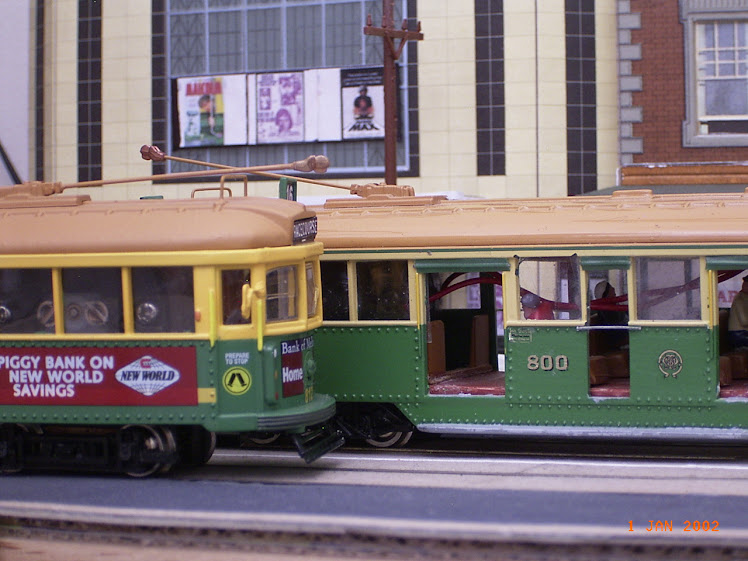
With the DCC conversion of the two Cooee Collectable RTR W class (964 & 812), the installation and programing of the decoders was easy, being can motors and smooth running at low speed; however the Bachmann Mechs (800 & 870) are completely different. Not only is the wiring unique, but all the phaffing around required when sorting through the CVs, for they can need a good kick in the arse to get going, then need a subtle touch on the throttle to stop them racing off at breakneck speed.

The other issue with installing decoders in the Bachmann Mech W class is the amount of real estate these units take up inside of the saloon, even more so when installing the lighting options as well. The W5 800 with its open three door drop centre section, per side, full of punters, really set the mind thinking of how to install a decoder, offer directional lighting and saloon lighting, all with one end of the car taken up by a pancake motor bogie...... (in the end, I think I may have nailed it.)

 
W5 800 (Bachmann Mech with NCE D13SRJ Decoder)
 
 
The underside of W5 800
 
 
So that's what I have been up to lately.
 
From under (amongst) the wires.
 
Glenn
 

Saturday, 24 November 2012

Computer games

Now I have finally crossed over to the DCC side, not happy with smooth running and multiple light functions, I pushed the boundaries even further, I hooked the laptop to the DCC using the NCE DCC usb interface, then to go that one step further again, I can now run the trams via wifi from my 'smartphone' all with the JMRI software and apps. I have achieved satisfaction.

The smartphone with JMRI controller.


 The NCE DCC usb interface.
(note the professional application of electrical tape)

The NCE DCC usb interface will be housed in a clear lidded zippy box so I can watch the LEDs light up as the computer and the Powercab chat to each other.

The ancient laptop which runs Windows XP with the JMRI software that allows 
myself to spend countless hours phaffing around with CVs.

Getting all this technology to work together required watching youtube vision, google searches, bad language and a few beers, best to be done when women and young children are not present.

*** SAFETY TIP*** 
When using your smartphone to run multiple trams be aware that incoming phone calls WILL result in losing control of your fleet as they will continue on with their last instruction, and you cannot stop the trams until you complete the call. 

From under the wires
Glenn


Saturday, 10 November 2012

Little Details - The Video

Some video evidence of the lighting functions I installed on W5 812 using DCC, yes, it was a challenge but it does encourage me to eventually install similar features to the rest of the fleet.


So sit back and wonder at how OCD I'm getting with DCC.
 
From under the wires
Glenn


Monday, 5 November 2012

My cup runneth over

As I started back in the model rail/tramway caper about four years ago after a long layoff from my mid teenage years. The time in between was taken up by the love of football and thoroughbred racing, (I was a really ordinary footballer and still not that great as a punter/owner either).

In that time I bought a house that is about a kilometre away from Flemington racecourse*, (the wife came later on), well this week is the spring racing carnival, last Saturday was Derby Day, tomorrow (Tuesday) is the time honoured Melbourne Cup(a public holiday), Thursday is Oaks (ladies) Day then the following Saturday is Stakes Day (cash permitting?).

As you can understand, it does get a little busy around here and as I have done for near the last twenty years, I take the week off work. This now gives me time on non racing days to 'run services' on Victoria Street, fit more DCC decoders and just be a Dad. (This explains why there is a racecourse on Victoria Street)


Best of both worlds.
Pretend races on the study shelf, real races on the laptop.
 
 DCC allows for tighter headway.

More mayhem outside the racecourse.
From under the wires and amongst the losing tote tickets,
Regards Glenn
*For those not from Australia, Flemington would be on par with Royal Ascot (UK), Churchill Downs in Kentucky (USA) or Longchamps (France)

Sunday, 28 October 2012

Little details

With the three trams fitted with DCC running exceptionally well, the thought of lighting comes to mind.
For some reason W5 812 is running a NCE D15SR decoder that has six function light outputs, (two extra outputs) I considered this not only a waste, but also a challenge.

So I lit up the multiple head/tail light assembly on the apron on each end of the tram.

812 indicating the turn from Victoria St into Epsom Rd.

Multiple head/tail light assemblies started making an appearance in the early 70's as part of a road safety push, the same time wearing seat belts became compulsory and driving after downing twenty beers in the pub also became frowned upon.

The layout of the lights on the trams is simple enough, three lights either side of the main head lamp, fitted to a fibre glass profile. The initial sequence from top to bottom was clear (front running), red (tail lamp) and clear again. Later when the Z,A and B classes were introduced, turn indicators and brake lights then became the norm, the W classes (which were being phased out except for the city circle line, #35 and #30 and #78/79) were retro fitted with turn indicators and brake lights within the existing light profile. The sequence from top to bottom is now clear (front running), amber (turn/hazard) and red (tail/brake).

It is the later profile that allowed me to use all the light functions of the decoder.

The LEDs that light the Multiple head/tail light are in the tram body and the light is transmitted through fibre optic threads to the apron, the LEDs and fire optic thread are attached using heatshink sleeving, the beauty of heatshink/fibre optic thread is that space is saved, and it allows easy connect/disconnect when untangling the inside of the tram.

 Some of the madness within.
 

964 with the original painted marker lights, 812 with hazard lights
on ready to negotiate the crossover.

The other end of 812.

Also, not to be outdone, 812 also has interior lights and cab lighting that also run off the decoder.
While not exactly true to the timeline of Victoria Street, The other trams with marker lights will run the original layout.

Yes, even my wife thinks that I am nuts.

From under the wires
Glenn

Tuesday, 16 October 2012

Dylan goes electric.

A bit like the post title, Victoria Street has crossed over, it now has added DCC!

I have finally accepted that for Victoria Street to improve operationally, it had free itself of the shackles of cumbersome (and extensive) block wiring.  While I could run scenarios to a fast clock, it lent itself to a repetitive rhythm of flicking switches and throttling a dubious DC controller and keeping an eye out for the section breaks in the trackwork.

So with a little birthday money and a little bit of online research, I have settled on the NCE powercab.


The new toy for the boy.


The first three candidates SW6 964, SW5 812 (both RTR versions) and X1 460.

"It's alive, mah ha ha ha ha!'
SW6 964 now fitted with DCC decoder (note light functions leads are shrinked wrapped until 
all that motor CV caper is figured out.....)


So with now these three trams running prototypical Melbourne like on Victoria Street, (nothing for ages, then three run Indian file trying not to rear-end each other). 

The decoder list now will have to blow out to suit another 4 W class cars, 3 other non standard MMTB trams(a U, an X, & Y class) , plus 2 blow ins from the bush (Ballarat 28 & Bendigo 29), not to mention my other exotics from Japan, Germany and the U.S.; therefore I will be up for a small fortune in decoders.$$$$$$.

Above all, I love the slow speed handling, and operational scope of this 'dark art'. (What the f*@& was I thinking with bog standard DC?)  

From under the wires, amongst the decoders and burnt by solder.

Glenn.


Saturday, 6 October 2012

Chinese whispers.

 
As part of the illumination and interior detail project, LEDs were retro fitted into the buildings at the Railway Station Module of Victoria Street, and as I do (quite often) then take photos of them and then post them to my Flickr account.
 
Well you could image my surprise, (and to my wife, much amusement) when a group on Flickr called Chinese Restaurant Worldwide Documentation Project invited this photo of the early evening in Victoria Street.
for a closer look
 
This group collect photos of Chinese restaurants that are not in China/Taiwan that sort of culture clash/mash themselves in their adopted environment.
 
The questions I ask myself is "Do they realise that this only a model?" and then "Who am I to question someones interest into something I think is somewhat obscure, for I do model and photograph trams" 
 
The world is a broad church, and things like this only adds to the rich texture of life.
 
From under the wires
 
Glenn