Crossing Paths

Crossing Paths
Model Melbourne trams

Tuesday, 7 April 2015

There's more than one way to skin a rabbit. (Easter)

The Easter weekend, so much to do, so little time. As with everyone else at this time of year, there is a requirement to catch up with friends and family.

 
Victoria Street gets a visit from the Easter guinea pig.

It started on Good Friday, drive east across town with the bride and kids to visit friends, while doing this, gladly chip in a few coins for the Royal Children's Hospital Good Friday Appeal at every intersection we stop at, then south to the outlaws to drop the kids off. Then back home so the bride can do her graduate diploma assignment, with a sly trip to the local pub for a counter meal.

Easter Saturday, I wake early to a quiet house, prepare myself for a trip to the Hobson's Bay Exhibition, the bride surfaces, a quick dash down the road for real coffee and croissants, then the bride settles down for study as I head off to the exhibition.

At the Union Hall at La Trobe University, I roll up just before opening, a quick chat with a bloke from work, then it's show time. With the renovations going on at the university, the exhibition is spread across three different levels of the building, with some layouts and traders hidden in rooms the size of broom cupboards, as there was not any published floor plan of the show, it's was somewhat reminiscent of a  M C Escher's drawing of forever climbing stairs.

Given the space constraints, there were some great layouts from far a field as Adelaide and Canberra, all being of Australian prototype. This time the wallet relented and I obtained some infrastructure.


- a foam servicing cradle,
 as I am fed up of knocking off the route number boxes
 off my W's every time they need a look over.
 
 
W5 800 having a lounge on the cradle.
Bachmann Mech with NCE D13SRJ decoder.


- a rerailer, for feeding rolling stock on/off the layout.
 
 
The rerailer in rest mode acting as a buffer at the
end of road three at the depot.
 
 
- and some tram related books.

On returning home, I was inspired to give some of my fleet the once over in the new cradle and shuffle them from the racecourse to the Ammo factory and back, again and again, much to the annoyance of the bride who at the time was having writers block down stairs.  After a directive to cease and desist, I thought it would be wise to suspend services, thus weather and detail the track at the Ammo factory.

With some die cut autumn leaves, water colour paints and a flock covered foam rabbit, details were added to the module. The foam rabbit (AKA future landfill) is one of those trendy items that is covered in a faux grass like flocking, unfortunately the ears were broken off, reattached, then broken off again. Now the rabbit resembles a guinea pig. The skin has been removed from the ears and clumps of weeds now flourish along the open ballasted tracks of the module, with more foliage along the rarely used siding.
 
The ears of the Easter guinea pig.
 
 
The Ammo factory, now featuring bunny fluff.
 
 
W5 800, doing some 'daisy cutting' on the siding.
 
 
Weeds with a dash of autumn leaves.
 
 
Now for the fence and the overhead.
 
Finally the bride had enough, so back to the outlaws late on the Saturday night, for the Sunday Easter egg hunt.

On the layout front, Sunday was a write off, and Monday morning was spent at a nephew's birthday party. Eventaully we make it back home, Monday afternoon, sans bride, who stayed the night her parents to finish off her assignment minus interrupting kids, myself as 'Mr. Mum' was kept from layout duties.

So much for a holiday long weekend.

From under the thumb,
Glenn.


Wednesday, 1 April 2015

Hooray! we are back on track.

Now that the shelving of personal injury project in the front room has been completed to the satisfaction of the domestic authorities, I can get back into working on Victoria Street.

 
Back running services.

The  Ammo Factory module is taking a rest at the moment while I tackle the construction of the road surface of the junction and the Depot.

My method of paving tram tracks involves the use of a lot of dense corrugated cardboard and several cereal boxes. I have tried various forms of plaster/filler in the past, but find the process extremely messy and it usually plays havoc with the electrical side of things with ordinary running results.

After pinning and glueing the bog standard code 100 track to the board, I build up the surrounding road surface with a couple of layers of dense corrugated cardboard (usually sourced from boxes of new small appliances, beer cartons while plentiful , are too corse and spongy for the task).  This is glued into place with PVA glue, the aim is to build to just under the rail head height.

In between the rails, strips of cereal boxes cut into 10mm wide strips, which are glued directly to the sleepers/ties. These strips are cut to smaller lengths (20-25mm) for the curves, which are glued in a brickwork like fashion, depending on the card three to four laminations are required to bring it up the under the rail head height.

 
From little things, big things grow.
The start of the road base.

The road surface for the tram tracks is made up of strips of cereal boxes that are 80mm wide, which are glued at right angles to the rails,  I draw a pencil line along the strip of card that is placed across the rails and with my fore finger I press down and run it along the rails underneath so the score the card with a mark that can be used as a cut line. The pencil line is a reminder of where you intend to glue the strip.

 
The first twenty foot wide slab being cast.

I score, mark, cut then glue each part of the strip as I work across the tracks, in between the rails the aim is to have a sample that is 14mm wide, so to allow for the flange ways. I like using PVA glue, because it allows the panel of strip to be 'floated' into position.

 
Scoring the strip parallel.
 
 
Checking for size.
 
 
Steady as she goes.
 
 
As I have not mastered the art of cutting a smooth curve with scissors, (most of my efforts look like the edge of a fifty cent piece), I knock the 'corners' off with some 240 grit wet/dry.
 
As with anything track related, testing while installing is a must, just in case one little install results the rollingstock going off for a wander. Here is a small gallery of the 'works in progress'.


Albert Rd and Victoria St
(Ammo Factory Junction)
waiting for the 'tarmac', 400 grit wet/dry sand paper
with office paper line markings.
 
 
The Depot, just waiting for the between the rails fit out.
 
 
While this may not be everyones cup of tea, the other reason I prefer this method, is that if there is any drama with points, track or wiring, I can apply a few drops of water, soften the PVA, then remove the affected part without resorting to a hammer and chisel.
 
 
This Easter Weekend marks the Hobsons Bay Model Railway Club Exhibition, this one exclusively exhibits layouts which are of Australian prototype, so no Thomas, British, or US, just Australian. Always a good exhibition to enjoy.
 
From amongst the road works at this end of the layout.
Glenn 


Saturday, 21 March 2015

And still nothing done.

The first week of my annual leave is almost done and not a cracker has been done on Victoria Street. As I work through the list of other tasks designated, the main one this week is improving the storage of books in the front room, which included a trip to the Swedish shop of flat pack furniture plus a side trip to the hardware store.

While this project may not be directly layout related, the construction of the 'library' will result in freeing up space in the man cave of literature..

So far the art of hanging cabinets on a wall the is twelve feet long and eleven feet high with a door in that wall, has utilised my years of engineering experience and know how.

All was going well with the mounting of the timber rails which will support the cabinetry until I received a short, sharp lesson in one of Newtons Laws of Physics, gravity!  Yes, I went base over apex off the ladder and trestle. The resulting crash together with an outburst of some old Anglo Saxon, had the bride running up the hall to see what mischief that I had done to myself.

As I lay somewhat uncomfortably on the floor and some construction materials, blinking and slowly doing a stocktake of potential injuries, the bride inquired if I was all right. (Does it look all right!)

I extracted myself from the mayhem slightly winded, nothing broken, nothing bleeding, but knowing full well that this will hurt eventually,  with the resulting bruising that is somewhat similar to ones that cranky thoroughbreds deliver.

After a coffee break, and some words of self belief such as "suck it princess", I tidied up the work area before Worksafe were notified, and continued on, a little more slowly and  carefully than before.

From under the debris in the front room.
Glenn.

Monday, 9 March 2015

On the road to nowhere.

After about three weeks of doing 3/5ths of 5/8ths of nothing, I ventured across town to the Labor Day Weekend exhibition at Sandown, just to have a look for some inspiration for Victoria Street, with my two girls in tow, little cash or time were spent at either at the vendors and/or the exhibiting layouts.

This exhibition is more aimed at the young and the young at heart, so this would have to be one of the very rare times that I have paid to walk into a racecourse, then walked out with the same balance in ones wallet that one entered with. All in all, it was the usual traders, exhibits and merchandise these shows have in common.

After dropping the kids off at the outlaws, I wandered off home to think of what needed to be done to the layout, hence the title, the road to nowhere.

 
The finished 'junction'
(road surface will hide the multitude of sins)


With Victoria Street undergoing an expansion, the concept of 'beyond' needed to be redefined  after extending the layout left of the railway bridge, then the end of the known world at 4mm/1'.   Therefore the new reverse curves now include a 'junction' going off scene into the foreground (Albert Rd) to the rest of the Melbourne tramway system.

The extra trackwork was made up of left over pieces of flexi track, nothing really scientific, rails of the diverging track soldered to one side of the running lines, rails for the crossing and points were filed, trimmed, and glued with five minute epoxy. The running rails were then given a few strokes of a needle file at the 'frogs' for the appearance of flange ways that provides the necessary clatter of tram traversing point work.

All of which managed to work with rollingstock without shorting out the Powercab.

The junction will now allow some tramway running rules such as-

     -trams from/to the branchline (Ammo Factory) shall give way to those trams from the city.
     -trams must make a compulsory stop at facing points, check setting before proceeding.

All of which is pointless, much like the 'junction'.

 
Setting the gauge of the point
(waiting for the epoxy to set)
 
 
A closer look at the junction
(note the gap between the diverging rails and the running rail
at the diamond so not to short out the Powercab)
 
 
Another angle of the tangle.
 
 
Give it another week, then I will be on annual leave, so the layout and rollingstock should get some attention after I complete the list of household projects as directed.
 
 
From the unwired end of the layout.
Glenn.


Wednesday, 18 February 2015

Slowly but surely.....

"Lost; time to work on layout, if found please contact me."

To say I have been busy lately would be an understatement, unfortunately this business is not layout related. Work and family life are the reasons why the progress on Victoria Street has slowed to a crawl.

Therefore the works on the 'Ammo' Factory are progressing, but very slowly, with the paving and track ballast installed, together with span poles, it is now starting to resemble something.

 
Slowly getting there,
The span poles are coathanger wire, the blobs of blu-tak
are there so I do not open myself up.
 
 
There will be a mesh fence between the factory and
the terminus, mesh has been applied to the ground floor windows.
 
 
An overview of the terminus and siding.
The checkrail for the siding prevents
rollingstock climbing into the factory.
 
 
I know it needs more grubbiness and details, plus some overhead.
Points are thrown by wire in the tube method.
 
Now some artistic shots...
 
 
SW6 870 waits patiently.
 
 
X1 460 on an excursion sits in the siding.
Photo taken through perspex end plate.


From the other side the tracks, still not under the wires yet.
Glenn


Sunday, 1 February 2015

Works at the 'Ammo' Factory.

As the tweaking of the track and rollingstock takes place with the new modules, the focus is shifting to the back scenes.  The Ammo Factory module will represent the industrial aspect of Victoria Street, with its open ballasted track and the new extra siding, it lends itself to more operational opportunities.

The building for the module is my rework of the classic Metcalfe Victorian warehouse kit, why reinvent the wheel I say, as with any other flat packed product, this offers a base from which you can start with, then it is a case of choose your own adventure, that is only limited by your imagination.
Therefore I cut off the bottom storey, and adapted it as an extremely thin low relief building (13 mm or so at the least).

 
A work in progress, poles, wire & ballast to come later.

Some of the windows were bricked up, some door places have windows, and an extra door was installed on the ground level.  The basis of the building is that the ground floor is workshop related, the next level is a light stores/technical area, then the top floor is for the administration/bureaucracy.

 
I made it up as I went along, the bricked up windows show the
retro fitted amenities/toilets, external plumbing to come later.

Like any bureaucracy, time keeping/wasting together with clock watching is a job in itself, this is why the 'Ammo' building has a clock mechanism provided from a cheap 'two bob' watch installed.

 
The tramways biggest bundy clock.
 
 
taking turns of moving the shift workers. 
 
 
An overview of the Ammo Factory module,
all 57cms of it in width.
 
As with most of the structures on Victoria Street, I only need a portion of the whole kit for my needs, the left overs will find a home in the 'asset register' for further use at a later date.

External and internal lighting will be installed, plus the usual debris of a working factory with weathering.

I could have wandered up the road to the West Maribyrnong terminus for more reference photos, but photographing government facilities in this day and age might land oneself in playing a game of twenty questions that maybe not worth the hassle, and definitely could not be considered as fun.

From the far end of the layout still not under the wires.
Glenn

Thursday, 15 January 2015

The ever expanding empire.

I have been busy, just like last year at about this time when I refurbished the man cave/study, this year has been no different, I am in the process of expanding the layout, and as you can guess, the clearance testing was a success.

 
An overview of the new/reworked modules connecting
with the rest of Victoria Street

With just a few alterations from the original draft, Victoria Street now features a now reworked fiddle yard which shall be called the 'Ammo Factory', in honour of the long history of the domestic armaments industry of the inner west of Melbourne, with a newly installed siding to cater for extra trams for shift changes and enthusiasts excursions.

This is fed by a set of reverse curves from the Victoria Street alignment, that has a spur line feeding a small three road depot that will be called the Albert Road (Westside) depot. All of which fits inside the prescribed boundary enforced by the domestic authorities.

Albert Road seems a pretty good fit with Victoria Street, aligning with the empirical nature of the times when a lot of subdivision of inner Melbourne took place, (for the record, I am not a royalist, but I reckon the Queen would be a nice lady to have chat to; however the rest of the family would be another story)

Some more photos......

 
A family mugshot on the depot fan.
 
 
A Birney and the X1 on a gunzel trip wait on the siding for the
regular service to depart at the 'Ammo Factory'.
 
 
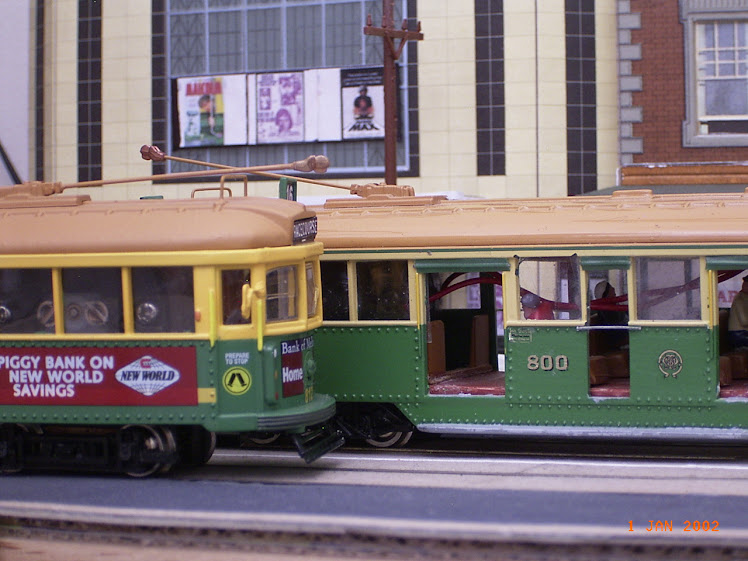
W5 800 waits for SW5 812 to proceed before
leaving the depot.
 
 
As X1 460 emerges from under the rail bridge, while
the two W's have a Mexican stand off.
 
 
This chicane module will be residential.
 
The Depot has a switch that can isolate it from the rest of the running lines, so in the event of DC running I do not have to remove DCC trams from the layout and so not to reprogram the rest of the fleet when setting/adjusting CVs while trial running/troubleshooting DCC rollingstock.
 
 
From not under the wires at this end of the layout.
Glenn.