Crossing Paths

Crossing Paths
Model Melbourne trams

Wednesday, 4 November 2015

Clocking up a milestone.

It is only just recently that this blog site, that has been online for the last four and a half years has passed the 50000 visitor mark,  I would like to thank those who regularly visit and those who leave the odd comment of encouragement for making this all possible, also those who post links from their blog to this one.

As you may have noticed there are no advertisements on or around this site, I intend to keep it that way as I have no interest in attempting to make money here, all I wish to do is post updates along with photos of the going ons of this model tramway layout, and hopefully inspire, educate and entertain you in the process.

Feel free to wander through the back catalogue of posts, and thank you again for your ongoing interest, for I believe that layouts are to be shared, either online and/or at an exhibition. We all can learn and appreciate from the efforts of others.

 
Thank you, from the locals of Victoria Street.
 
From under the wires after 50000 odd visits.

Glenn.

Sunday, 25 October 2015

This is how we roll.

Just a quick update, I have obtained a set of rolling road (DCC Concepts) for Victoria Street, this will allow myself to fine tune DCC equipped rolling stock and run in some of my recent/sticky DC trams.

This is because there isn't enough running space on the layout for my fleet to get a good gallop up before it finds itself at the other end, and as a point to point shelf layout there also not enough real estate for a complete loop for some "roundy, roundy" action.


'Mind the step'

With enough roller assemblies for six axels, I have the resources to give three, four wheelers a whirl at one time, also the set includes spacers for those who choose to operate in other gauges, now to get the good laptop off the bride so I can start dyno testing the DCC fleet with JMRI.


A closer look.

Eventually I will set up some track on a plinth with both HO and N scale, with a feed from the layout operated/isolated by a switch, for running in/ programming purposes, as the only place I can slot these rollers on the layout is on the open ballasted track at the Ammo factory module

Watching the wheels turn but not going anywhere,
Glenn.

Friday, 25 September 2015

Lights are on.

The work at the moment is concentrating on structure lighting, on the junction module, the servo, the depot administration office and the terraces are now fitted with internal lighting. The old house is not far behind, but will be fitted with a quick connect plug and socket so I can remove the house for depot photos. I even knocked up a hills hoist.


Even the incinerator is illuminated
(The missus will be impressed with the washing on the line)

While the soldering iron was hot, other projects got a go, including an effort of interlocking tram signals for the depot, considering that for a tram to enter the depot, it has to 'bang road' against traffic coming from town and the depot. It involves the combination of a micro limit switch (point direction), a DPDT switch (car in/car out), plus some spare LEDs acting as a diode matrix, feeding a set of pole mounted modified LEDs fashioned to look like tramway 'T' lights, the concept seems to work and is waiting for the Soldering of lights festival beneath the modules.


Testing the 'brains' of the tramway signals.

 
Set against leaving the depot.
 
 
Set against through traffic,
 
 
with a repeater for traffic coming from the Ammo Factory.
 
 
Set against Depot entry.
 

The other episode of cauterised flesh is the lighting assembly for the interior of the depot shed, this features LEDs sourced from Christmas lights soldered along a strip of double sided copper clad PCB board together with some code 100 rail for uprights.  The other trick that I employed is insulating the lighting circuits from the contact wire by cutting gaps on the strips where the contact wire (code 80 Peco N gauge rail) is soldered to the PCB strip.  Bridging wire for the lights are soldered over the contact wire pads.

The concept of this arrangement is that the depot shed to be constructed from foam board, covered in brick paper, complete with a roof that can be 'plonked' over lighting rig/shed overhead, and removed on the occasion of a stalled tram, a dewired trolley pole or a tangled pantograph.

 
In the daylight.
 

The code 80 N scale rail with a wheel type trolley pole,


and with the slider type trolley pole.


then at night
.


"Let there be light"

The reason for the lack of posts at the moment is due to the bride tying up the internet connected laptop with her studies, leaving myself to compose posts on the tablet/smart phone in text form then uploading the photos for the posts when the laptop becomes available, this issue will cease about Cup week (early November) when her studies finish for the year.

From under the wires minus fingerprints,
Glenn.


Thursday, 27 August 2015

Where are the trams?

"Due to a long running industrial dispute, together with a stop work meeting today between 10 am and 2 pm there will  not be any trams services along Victoria Street during that time, delays are anticipated before the stop work action and when services are restored."


'Passengers are to expect some issues with services.'

As in the past and as now in the present, industrial disputes between staff and management occurs when  there is a difference of opinion on how the business operates, most disputes are usually about remuneration and workplace conditions.

In today's workplace environment, certain parties believe that for workers to receive extra income they must trade away long fought for entitlements and conditions, thus improving the 'efficiency' of the business.  The flip side of the argument, is that the worker can only do so much with the equipment that is available at a certain rate that does not endanger themselves or others, while expecting renumeration that enables them to sustain/improve their current standard of living.

The days of spontaneous wild cat industrial action, together with secondary boycotts are long gone, the process now involves mediation through an independent industrial umpire; however, this process can only work if both parties agree on a suitable outcome, now known as an enterprise bargaining  agreement. When this fails, the workers representative can apply for a protected industrial action ballot amongst its members, to gage the feeling of the intent to engage in further industrial action, the result of the ballot can enlighten management to the ill feeling of their workforce, therefore make a more suitable offer in an attempt to prevent possible damaging industrial action.

When the result of the dispute, which willl affect the travelling public, this action gains the interest of the media, who in turn may publish certain details about the workers current wages and conditions that is supplied/inflated by the management in an effort to push the public against the worker. This is not negotiating in good faith.  The workers now have to give significant notice about their intention to withdraw their labour, so the travelling public can make alternative arrangements, this in turn places the ball in the court of the business to come up with a solution that is palatable for the workers before the deadline.

The withdrawal of labour is usually the last thing that the workers want to do as it results in loss of income for that period, as some workers may not have the resources to sustain that short term loss, however, the alternative that is the combination of an uncompetitive wage together with reduced conditions which may include reduced job security means that the workers have no other alternative but to engage in industrial action.

Hence the cameo at the front gate of the depot.

Unity from under the wires.
Glenn.


Sunday, 9 August 2015

Watching the grass grow.

A little bit of horticulture has taken place at the junction, the old house is bedded into some natural surrounds, some badly kept lawn and a couple of trees. The grass came from the Easter guinea pig, and the trees are Noch.

The grass came off in clumps from the donor rabbit, so when glued to the painted 'dirt' around the house it does look more realistic than the 'hair raising' method of a static applicator*, this allows the clumps to show a hint of terra firma between the foliage while not being dragged the same way by the laws of physics.

 
'An established neighbourhood'
 
 
In keeping to the time frame of years past before the local authorities (Council/EPA) ruined the art of backyard pyromania involving waste disposal, we have an incinerator fashioned from a 44 gallon drum. (Today they are called fire pits, braziers and chimineas!)
 
 
"Ahh, the serenity"
 
 The drive way, house, vehicles and chattels all received a dusting of pan pastels for that hint of neglect.


A small corner of the world.
 
 
A dull winters afternoon.
 
 
The back yard.
 
 
All that is missing is the Hills Hoist.
 
 
*A static applicator was discussed about with the domestic authorities, but was knocked back due to the potential of a mess during the process and the small amount of real estate requiring treatment, the short answer was NO! 
 
 
From next to wires while watching stuff burn with a few beers.
Glenn


Friday, 17 July 2015

This old house

I have finally got around to completing that house I started in March last year, this was before I became distracted by the invitation to the Caulfield Exhibition that year.

The saga of the house goes like this,

- I found a kit in the back of the cupboard after the refit
- Start building the house
- Obtained invitation to Caulfield
- Put house in study cupboard
- Completed other tasks for exhibition
- Unattended nephew, niece and youngest daughter find house in study cupboard
- Then they 'remodel' the house
- I find house needing some work with one window missing
- Repair house, make missing window into a box aircon conversion
- then find missing window after rework.

Then it was forgotten until the layout expansion, then it was plonked on the layout as potential.

Since then, the construction of buildings on the new modules has gone full parallel ahead, the servo, the depot admin building, the terraces and finally this old house.

This again is another local production, 'Grosvenor Cottage' by BC Models, a highly detailed full coloured printed card kit, HO scale but it works on Victoria Street. As per usual, I have taken some artistic licence with it, the installation of 'fibro' on the rear, then the fit out of alfoil corrugated iron on the roof, together with the addition of a back veranda, plus some external plumbing.

 
'God's own country'
 
 
'it may not be much, but it's home'
 
 
'position and potential'
 
 
The long view from the Ammo Factory terminus
(note the beverage chimney in the background)
 
 
Welcome to 'Plonksville' junction
(nothing is fixed yet, nor are the chimneys)
 
 
The eventual concept of this house is that it is removable so I can take photos of the depot at ground level.
 
From my ever expanding property portfolio under the wires.
Glenn


Friday, 10 July 2015

Some urban density.

Another structure has been built to add to the Junction module, in typical inner urban style a row of Victorian Terrace Houses, this is a local kit that features the style that lined the main roads and back streets of inner Melbourne.

 
Urban Reality

These houses are modelled on the British 'two up and two down' but have verandas/porches on the exterior in an effort to tame the Australian summer, usually of brick construction, these houses were built for the working class that served the industries of a inner suburbs.

For a fair time these sort of properties housed tenants that were on the lower end of the social economic scale, Melbourne suburbs such as Fitzroy, Collingwood, Richmond and Carlton are still full of these houses, but the demographic has moved on from the working poor, migrants and university students to urban professionals (yuppies/trendies/dinks) and recently the hipster generation. This is due to the proximity to the central business district/city centre.

A certain number were obtained and demolished by authorities after the second world war as these were the worst of slum housing, and were replaced by prefabricated concrete high rise flats (public/community housing), a concept that still reverberates to this day.

The era I am trying to capture is the transition from a gritty working class area to gentrification, each of the three houses tell a story, the left house features a 'home business', the second/middle house a student share house, the right a recently renovated/restored home.

 
Student share house
(I just noticed I have not fitted the facia board)

The kit while basic, was improved with addition of printed brick sheet, and the course of bluestone foundation, is a strip of 600 grit wet/dry sandpaper. The middle house has had the top veranda built in as an extra room using my 'Fibro' technique. The kit came with printed windows and iron lace work that offers some character, and as with all structures on Victoria Street, was extensively kit bashed to fit in as a low relief structure.

 
The fast filling junction module.
 
There are still some more details to add such as chimneys and weathering. All the buildings on this module are not fixed to the surface as yet, so I can finalise positions of span poles and the trolley wire, also a back board needs to be installed to all newer modules.   
 
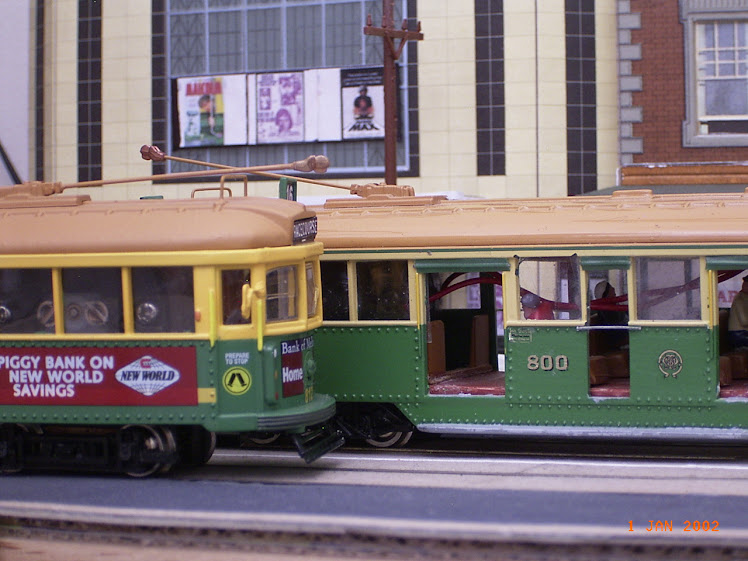
Gratuitous tram photo.


From another time before hipsters sat around on milk crates stroking their beards while sampling bespoke micro brewed beer from jam jars after riding their fixed wheeled pushbikes.
 
 
'Heading out to the races'
 
 
'A quiet Saturday afternoon'
 
 
From the wrong side of the tracks.
Glenn